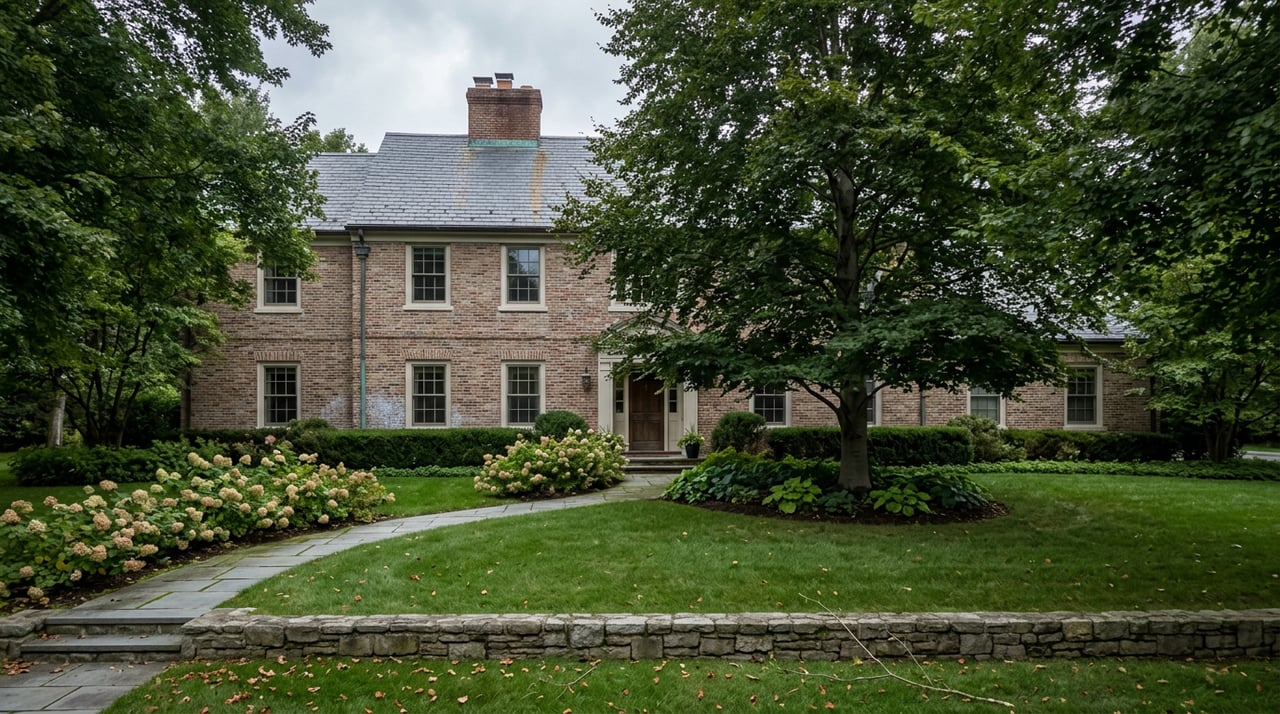
Meridian Hills Has Its Own Government. That's Why Its Housing Numbers Look So Strange.
September 17, 2026
September 17, 2026
On June 8, 2026, paving crews from Howard Companies rolled into Meridian Hills to start the town's annual road resurfacing program. Not Indianapolis's citywide paving schedule. The town's own program, funded and contracted by a town government most house hunters have never heard of, sitting inside a city that most people assume runs everything north of 38th Street the same way.
That detail matters more than it looks like it should, because it explains something that trips up almost everyone shopping this pocket of the north side: why the price data for Meridian Hills seems to contradict itself depending on which site you're looking at, and why that contradiction is really a governance story wearing a market story's clothes.
Pull up two different market trackers for Meridian Hills right now and you'll get two different pictures. One shows the average home value sitting around $744,000, up a modest 3.4% over the past year as of the end of May 2026. Another shows the median sale price over the three months ending in May 2026 at just under $1 million, up 31% year over year, with the price per square foot up nearly 25%.
Those aren't two competing opinions about the same market. They're two different math problems applied to a town so small it barely generates enough transactions to do math on. Eight homes sold in May 2026, up from six the same month the year before. A June snapshot of active listings showed only five homes on the market, with a median list price of about $745,000, a number that lines up far better with the average-value figure than with the eye-popping median.
That's the tell. When a market moves eight homes a month, a single large closing on a wooded estate lot doesn't nudge the median. It hijacks it. Meridian Hills has been quietly building out Meridian Pointe, a small enclave of luxury wooded homesites on a former estate across from the country club, with asking prices stretching into the millions. One or two of those closings landing in the same quarter as several ordinary ranch and colonial sales is enough to pull a three-month median up 31% without the underlying market actually repricing by anything close to that.
If you're comparing Meridian Hills to a neighborhood like Meridian-Kessler or Butler-Tarkington, where dozens of homes trade every month and a single sale can't distort the average, you're not comparing like to like. You're comparing a deep pool to a puddle, and the puddle's temperature swings wildly every time someone drops a rock in it.
Here's the part that actually explains the puddle. Meridian Hills isn't a neighborhood the way Broad Ripple or Fishers is a neighborhood. It's a town, incorporated in 1937, that got folded into the city of Indianapolis in 1970 under Unigov, the consolidation that merged most of Marion County's government with the city. Sixteen small municipalities negotiated their way into the new arrangement as "included towns," meaning they kept their own local government even after the city absorbed everything around them. Meridian Hills was one. Williams Creek, just to the north, was another. Homecroft, on the south side, was a third.
An included town keeps the right to pass its own ordinances, provide its own local services, and levy its own property tax, all while its residents still get the broader municipal services Indianapolis provides everywhere else. In practice, that means Meridian Hills isn't relying on the city to decide when its streets get repaved. It contracts that work itself, which is exactly what was happening on those roads in June 2026. It also means the town appoints and funds its own police department, a separate operation from the Indianapolis Metropolitan Police district that covers the surrounding area, posting its own activity summaries on the town's website rather than folding into a citywide report.
None of this is a story about who's doing a better job. It's a story about scale. A town this size, running its own government layer inside a city of nearly a million people, is going to have a housing market that behaves like the town it is, small, thin, and easily distorted by whichever handful of houses happen to close in a given quarter, rather than like a neighborhood embedded in a much larger, more liquid system.
That governance layer isn't free, and it isn't cosmetic. It shows up as its own line on the property tax bill, on top of standard Marion County and Washington Township rates, because state law gives the town its own taxing authority. It's a real, if modest, added cost of the address, and buyers used to shopping tax bills in a normal Indianapolis neighborhood should expect this line to appear even though the streets look no different from the ones just outside the town line.
Here's how that plays out next to two neighborhoods this brand covers regularly, both large, standard Indianapolis neighborhoods without a separate town government layered underneath them.
| Area | Own town government | Sets its own property tax | Own police department | Contracts its own road work |
|---|---|---|---|---|
| Meridian Hills | Yes, included town since 1970 | Yes | Yes | Yes |
| Meridian-Kessler | No | No | No, IMPD | No, city schedule |
| Butler-Tarkington | No | No | No, IMPD | No, city schedule |
The table is short because the answer is short. Meridian Hills is doing something structurally different from its neighbors, and that difference is baked into the price of admission, not layered on top of it as an amenity fee.
One more wrinkle worth knowing before you fall for a listing photo. Almost all of Meridian Hills sits inside the Washington Township Metropolitan School District, but one block of the town is zoned into Indianapolis Public Schools instead. The town's boundary and the school district's boundary don't perfectly overlap, which is a common enough quirk in Marion County but an easy one to miss when a listing description leans on the town's name as shorthand for a school assignment.
If a specific school is part of why you're looking at Meridian Hills, don't take the neighborhood name as confirmation. Confirm the address. The town is a real, bounded municipality, but the lines that govern schools, police response, and tax rates don't all trace the same shape, and the only way to know which lines apply to a specific house is to check that house, not the town it happens to sit in.
Do homes in Meridian Hills pay a separate property tax bill from the rest of Indianapolis? No, it's one combined Marion County tax bill, but the town's own taxing authority under state law adds its own rate to that bill, funding services like the town's police department and its road contracts separately from what the city provides elsewhere.
Who responds if I need police in Meridian Hills? The town appoints and funds its own police department rather than relying on the Indianapolis Metropolitan Police district that covers the surrounding area, and it posts its own activity summaries through the town's website.
Does living in an included town change my school district? Usually not. Most of Meridian Hills is zoned to Washington Township Metropolitan School District, but one block falls under Indianapolis Public Schools instead, so it's worth confirming school assignment by the specific address rather than assuming the whole town shares one district.
If you're weighing a house in Meridian Hills against something in a neighboring Indianapolis neighborhood, the price tag is only half the comparison. The other half is the layer of government that comes with the address, and what it actually does for you day to day. That's the kind of thing worth working through with someone who knows the difference before you write an offer, not after. Carly DeFazio has spent over a decade helping buyers read past the headline number on Indianapolis's north side. Let's Connect and figure out what a specific address actually buys you.
Stay up to date on the latest real estate trends.





Real estate is more than a transaction-it’s a transition. I guide clients through buying and selling with calm leadership, proactive strategy, and a thoughtful, highly personalized approach. Every detail is considered, every move intentional, so you can feel confident not only in the outcome, but in the process itself.